Disco
DAG810
The DAG810 is a compact automatic surface grinder. The DAG810 can thin single wafers, stacked wafers, or chips from a few mm² to full 8-inch wafers at speeds up to 30 microns/min. The DAG810 achieves a total thickness variation close to one micron and a surface roughness less than 100 nm.[1]
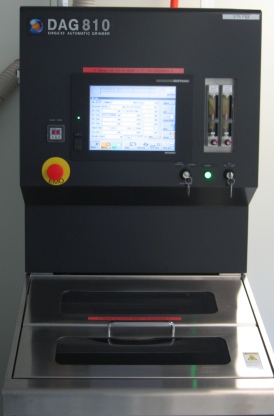
Plate 01Disco DAG 810 Demo Vid 3
Ollie Dunne Tara SemiWatch on YouTubePlate 02Disco DAG 810 Demo vid 2
Ollie Dunne Tara SemiWatch on YouTubePlate 03Disco DAG 810 Demi Vid 1
Ollie Dunne Tara SemiWatch on YouTubePlate 04Disco DAG810 Wafer grinder 디스코 그라인더
링크머신 제조업 중고기계거래 플랫폼Watch on YouTubePlate 05DAG 810
Turners Machinery A Div. of Retrofit to CNC Inc.Watch on YouTube
What it is
The DAG810 is a compact automatic grinder for silicon, III/V materials (GaN, GaAs, InP), and various glass types including fused silica, float glass, and pyrex. The DAG810 thins single wafers, stacked wafers, or chips from a few square millimeters up to full 8-inch wafers.[1]
How it works
The DAG810 clamps workpieces to a rotating chuck table. A rotating diamond wheel sweeps across the center of the chuck table. The spindle carrying the wheel moves downward to remove material from the surface of the workpieces. Water cools the workpieces and clears particles and mud generated during grinding. Fine control of the spindle vertical displacement, along with precise angular adjustments with the chuck table, produces a flat ground surface with a total thickness variation (TTV) close to one micron.[1]
The thickness reduction is accomplished in two or three different phases by decreasing the feed speed of the grinding wheel as the finishing thickness approaches. The DAG810 achieves a grinding speed as high as 30 microns per minute and a surface roughness less than 100 nm. The equipment includes a universal vacuum chuck table for 4-inch, 5-inch, 6-inch, and 8-inch wafers, a mechanical frame clamp for UV-tape mounted wafers or chips, a high-rigidity low-vibration spindle, and dedicated grinding wheels for different materials. Real-time probe-height measurement is available for 4-inch wafers and larger. An LCD touch screen provides operation control. Some manual operations are required: wheel selection and installation, axis initialization, probe-height initialization, wafer thickness measurement, workpiece loading and unloading, and UV-tape mounting, cleaning, and curing.[1]
Where it fits in the process flow
The DAG810 is typically employed in a process that includes mounting workpieces on UV-sensitive tape using a manual wafer mounter (Powatec P-200). After grinding, the workpieces are cleaned and dried in an automatic cleaner (Disco DCS1440) that uses atomizing cleaning and fast spinning. The cleaned thin workpieces are then safely released by exposing the tape to UV light using a manual UV irradiation system (Powatec U-200). A technique called Dicing Before Grinding (DBG) can be used: dies are separated by grinding after half-cutting the workpieces to relieve edge stress.[1]
Applications
The DAG810 grinds single wafers of silicon (100 mm to 200 mm diameter), gallium nitride (GaN) on 2-inch wafers, and glass wafers including fused silica, pyrex (borosilicate), and soda-lime glass. The DAG810 also grinds stacked wafers such as pyrex/silicon anodic bonds, silicon/silicon bonds, and silicon/glass bonds. Chips mounted on UV tape, including GaN and silicon chips of various sizes down to a few millimeters, can be thinned. Tested reductions include thinning silicon wafers from 525 µm to 100 µm and from 625 µm to 200 µm, thinning GaN wafers from 320 µm to 100 µm, and thinning stacked silicon to 30 µm or 50 µm.[1]
- thinning single wafers
- thinning stacked wafers
- thinning chips
- coarse and fine silicon grinding
- coarse and fine glass grinding
- GaN fine grinding
Why won't it start?
Documented failure modes, common issues, and field considerations.
- probe-height is not usable with chips, wafers with topography, and wafers smaller than 4"
- ground surfaces are always damaged after grinding
- a micro-cracked layer is present after grinding
- wafer edges can become sharp during grinding and may induce breakage depending on final thickness
What do the numbers mean?
Vacuum & pumping5
- Chucking
- one universal vacuum chuck table; one mechanical frame clamping for UV-tape mounted wafers or chips[1]
Wafer handling8
Optics & imaging1
Control & software3
Dimensions & facilities1
Configuration & options20
- Materials
- silicon, III/V materials (GaN, GaAs, InP), and various glass types (pure amorphous SiO2, float glass, pyrex)[1]
- Grinding wheels
- dedicated wheels for coarse and fine silicon grinding, coarse and fine glass grinding, and GaN fine grinding[1]
- Grinding wheels
- Dedicated grinding wheels for coarse and fine silicon grinding (2 different wheels), coarse and fine glass types grinding (2 different wheels), GaN fine grinding (1 wheel)[1]
- Materials processed
- Silicon, III/V materials (GaN, GaAs, InP), various glass types (pure amorphous SiO2, float glass, pyrex)[1]
- Materials processed
- Silicon, III/V materials (GaN, GaAs, InP), glass types (pure amorphous SiO2, float glass, pyrex)[1]
- Wheel types
- dedicated grinding wheels: coarse and fine silicon, coarse and fine glass, GaN fine[1]
What does it need to run?
Site utility requirements, footprint, and infrastructure needed to install and operate this tool. Sourced from public records.
- Wafer sizes supported by universal vacuum chuck table4", 5", 6", and 8"[1]
- Chuck tableOne universal vacuum chuck table for 4", 5", 6", 8" wafer sizes[1]
- Chuck tableUniversal vacuum chuck table[1]
- Chuck tableone universal vacuum chuck table for 4", 5", 6", and 8" wafer size[1]
- Chuckingone universal vacuum chuck table; one mechanical frame clamping for UV-tape mounted wafers or chips[1]
Where are the manuals?
Generated from public-source data on file. Enter your email to access — nothing is published; details are routed privately.
Not publicly documented
Field notes
No research found yet — worked with this tool? Share what you know.
Frequently asked questions
What materials can the DAG810 grind?
The DAG810 can grind silicon, III/V materials (GaN, GaAs, InP), and various glass types including pure amorphous SiO2, float glass, and pyrex.[1]
What is the maximum wafer size the DAG810 can handle?
The DAG810 can handle wafers up to 8 inches in diameter, with a universal chuck table for 4-inch, 5-inch, 6-inch, and 8-inch sizes.[1]
What grinding speed and thickness variation does the DAG810 achieve?
The DAG810 achieves a grinding speed as high as 30 microns per minute and a total thickness variation (TTV) close to 1 micron, with surface roughness less than 100 nm.[1]
How many grinding phases does the DAG810 use?
The DAG810 accomplishes thickness reduction in two or three different phases, decreasing the feed speed of the grinding wheel as the finishing thickness approaches.[1]
What associated equipment is used with the DAG810?
The DAG810 is used with a manual wafer mounter (Powatec P-200), a UV irradiation system (Powatec U-200), and an automatic cleaner (Disco DCS1440) for cleaning and drying workpieces after grinding.[1]
Not publicly documented
The following facts about the DAG810 are absent from this record as of this revision. First-hand knowledge or a citation closes a gap; every submission is reviewed before publication.
No publicly documented production dates or lifecycle milestones (introduction, end of production, EOL) for the DAG810 are on record.
Answerable by: OEM historical records or a trade-press announcement
No publicly documented variants, configuration options, or revision breakpoints of the DAG810 are on record.
Answerable by: an OEM product catalog or an engineer who ordered or specified the tool
The control-system platform and OS era of the DAG810 are not on record.
Answerable by: an engineer who operated it or OEM installation records
The process node or technology generation of the DAG810 is not on record.
Answerable by: an OEM datasheet or a fab qualification report
No publicly documented compatible parts, consumables, or accessories for the DAG810 are on record.
Answerable by: an OEM parts catalog or a service engineer
Sources & citations
Sources (2)Every fact above is drawn from these public sources
- [1]epfl.ch — epfl.chepfl.ch
- [2]研削机 | 800系列半自动研削机 - DISCO Corporation — disco.co.jp (Sep 4, 2014)web.archive.org
Last updated Oct 8, 2026.
Compare with similar tools
View all →
The Lapmaster Model 15 is a bench-mounted unit with a rigid, lightweight, cast aluminum base, of the 'ring lapper' configuration, enabling high standards of flatness and surface finish.

General referenceThe Blanchard 18 D Surface is a vertical-spindle rotary-table surface grinding machine used to produce flat, parallel surfaces on metal workpieces.

The Blanchard 20 36 Surface is a surface grinder used in dicing and grinding applications.
