Esec
Datacon 2200 evo advanced
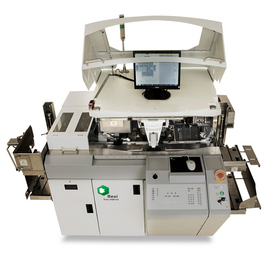
The Esec Datacon 2200 evo advanced is a die bonder for epoxy die attach applications. The Esec Datacon 2200 evo advanced is a 300 mm high-speed platform. The Esec Datacon 2200 evo advanced supports wafer sizes from 4 inches to 12 inches on 8-inch or 12-inch wafer frames.[1]
Plate 01datacon 2200 evo besi 2200 evo series die bonder semiconductor equipment machine
GEEKVALUE SMT SolutionsWatch on YouTubePlate 02Datacon 2200 evo
GEEKVALUE SMT SolutionsWatch on YouTubePlate 03Besi Datacon 2200 evo and Datacon 8800 Series die bonder /die bonding machine
GEEKVALUE SMT SolutionsWatch on YouTubePlate 04Datacon 2200 EVO Demo Video
Ollie Dunne Tara SemiWatch on YouTubePlate 05BESI Datacon Die Bonder/bonding machine: datacon 2200 evo/8800 FC Quantum
GEEKVALUE SMT SolutionsWatch on YouTube
Wafer size
4"
Performance
20 µm @ 3σ (15 µm option)[1]
What it is
General reference — not yet source-verifiedDie bonders perform the task of picking singulated dies from a wafer or other carrier and placing them onto a substrate, such as a leadframe, a laminate, or another die, with precise alignment and controlled bonding force. The Datacon 2200 evo advanced is one variant of a platform that offers scalability of performance and process capabilities.
How it works
General reference — not yet source-verifiedThe Datacon 2200 evo advanced uses a pick-and-place mechanism to transfer dies from a wafer or tape to a bonding site. The system typically incorporates a multi-module architecture, allowing multiple bond heads to operate in parallel or independently to increase throughput. Vision systems align the die and substrate to achieve precise placement. The bond head applies a controlled force and may use heat or ultrasonic energy to attach the die, depending on the process material.
Machine operation includes wafer handling to present dies to a pick-up station, where a collet or a bonding tool lifts the die from the wafer tape. After picking, the die is transported to the bonding position where it is placed onto the substrate. The die attach process can use adhesives such as epoxy or solder, or it may involve direct bonding techniques like eutectic or thermo-compression bonding. The system includes automated material handling for substrates, such as magazines or strips.
Where it fits in the process flow
General reference — not yet source-verifiedIn multi-die packaging, the Datacon 2200 evo advanced can place multiple dies onto a single substrate, enabling system-in-package or multi-chip module configurations. The machine is typically positioned downstream from wafer preparation and upstream of inspection or wire bonding stations.
What can it run?
Process applications and technology nodes documented for this tool.
- TSOP
- FBGA
What do the numbers mean?
Wafer handling1
Performance1
Dimensions & facilities2
Configuration & options3
Vintage & configurations
Where are the manuals?
Generated from public-source data on file. Enter your email to access — nothing is published; details are routed privately.
Not publicly documented
Field notes
No research found yet — worked with this tool? Share what you know.
Not publicly documented
The following facts about the Datacon 2200 evo advanced are absent from this record as of this revision. First-hand knowledge or a citation closes a gap; every submission is reviewed before publication.
No publicly documented production dates or lifecycle milestones (introduction, end of production, EOL) for the Datacon 2200 evo advanced are on record.
Answerable by: OEM historical records or a trade-press announcement
The control-system platform and OS era of the Datacon 2200 evo advanced are not on record.
Answerable by: an engineer who operated it or OEM installation records
No publicly documented failure modes or field errata for the Datacon 2200 evo advanced are on record.
Answerable by: a field service engineer, process engineer, or maintenance technician
The process node or technology generation of the Datacon 2200 evo advanced is not on record.
Answerable by: an OEM datasheet or a fab qualification report
No publicly documented compatible parts, consumables, or accessories for the Datacon 2200 evo advanced are on record.
Answerable by: an OEM parts catalog or a service engineer
No research found yet — worked with this tool? Share what you know.
Sources & citations
Sources (1)Every fact above is drawn from these public sources
- [1]besi.com — besi.combesi.com
Last updated Oct 2, 2026.
Compare with similar tools
View all →The Esec 2009 fS E is an epoxy die bonder for 300 mm high-speed die attach applications. The Esec 2009 fS E supports wafer sizes from 4" to 12" on 8" or 12" wafer frames.
The Esec 2100 hS i is a die bonder for epoxy die attach applications. The Esec 2100 hS i is a 300 mm high-speed platform with support for wafer sizes from 4 inches to 12 inches on 8-inch or 12-inch wafer frames.
The Esec 2100 sD advanced i is a die bonder for epoxy die attach applications. The Esec 2100 sD advanced i is described as a 3rd generation 300 mm high speed platform with 20 µm bonding accuracy and an optional 15 µm placement accuracy in High Accuracy Mode.

The MRSI 505 Die Attach is a packaging and bonding machine for semiconductor assembly, used for die attach and multichip module work.
The Datacon 2200 evo is a die bonder for epoxy die attach applications.
The Esec Datacon 2200 evo hF is a die bonder on Besi's 3rd-generation 300 mm high-speed platform. The Esec Datacon 2200 evo hF is specified for epoxy die attach applications and supports wafer sizes from 4" to 12" on 8" or 12" wafer frames.